
Oak AI
Reconsider an audience assumption before the next study.
Qualitative coding brought privacy and trust concerns into a discussion about audience fit and research priorities.
- My role
- Lead UX Researcher
- Period
- September 2024
- Delivery stage
- Qualitative synthesis · audience and research-priority recommendations
The problem
Oak was exploring an audience that cared about privacy and the use of personal data. The team needed to understand whether its product direction addressed those concerns in a way that would feel useful and credible.
My contribution
I examined community discussions and coded qualitative material in Dovetail. I used the patterns to question our audience assumptions and help decide whether deeper research in this direction was the best next investment.
Begin with the concerns people were already discussing.
Community observation gave me a view of the language and concerns already present in privacy discussions. I organized excerpts with tags such as Data Security, Corporate Accountability, and Personal Data & Online Safety. The retained coding export provides a trace of that work; it is a partial record rather than a complete study count.
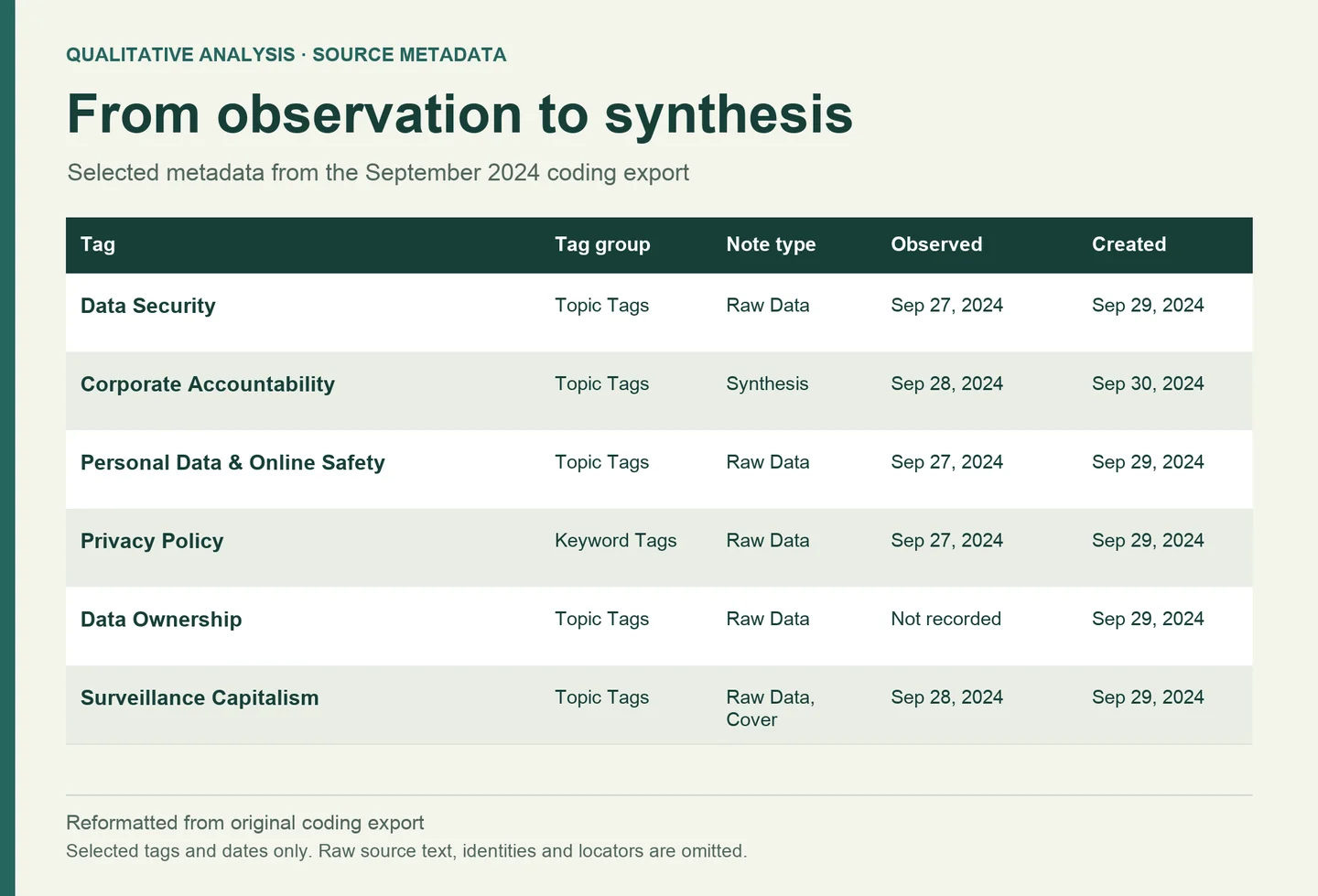
What the retained coding structure shows
| Selected tag | Tag group | Note type in the displayed excerpt | Observation record |
|---|---|---|---|
| Data Security | Topic Tags | Raw Data | September 27, 2024 |
| Corporate Accountability | Topic Tags | Synthesis | September 28, 2024 |
| Personal Data & Online Safety | Topic Tags | Raw Data | September 27, 2024 |
| Privacy Policy | Keyword Tags | Raw Data | September 27, 2024 |
| Data Ownership | Topic Tags | Raw Data | Not recorded in the selected row |
| Surveillance Capitalism | Topic Tags | Raw Data, Cover | September 28, 2024 |
These rows demonstrate the retained coding structure. They are not participants, a complete codebook, or a count of distinct findings. A tag may appear on multiple notes and note types.
Reasoning and tradeoffs
Why this mattered
Community observation exposed concerns already being discussed: how data was collected, how it was protected, and whether companies were accountable. I tagged source excerpts and kept them available for synthesis rather than reducing the material to a single label of trust.
The options
The archive also contains an active-engagement plan intended to elicit more conversation. That approach could surface additional detail, but its proposed prompts emphasized frustration and product-adjacent concerns. Responses to those prompts would need to be interpreted separately from unprompted discussion.
The tradeoff
Observation can reveal language and recurring concerns without asking people to react to a product pitch. It still reflects the community and material selected for review. Active questions can go deeper, while also shaping the topics and tone of the replies.
Keep trust connected to something concrete.
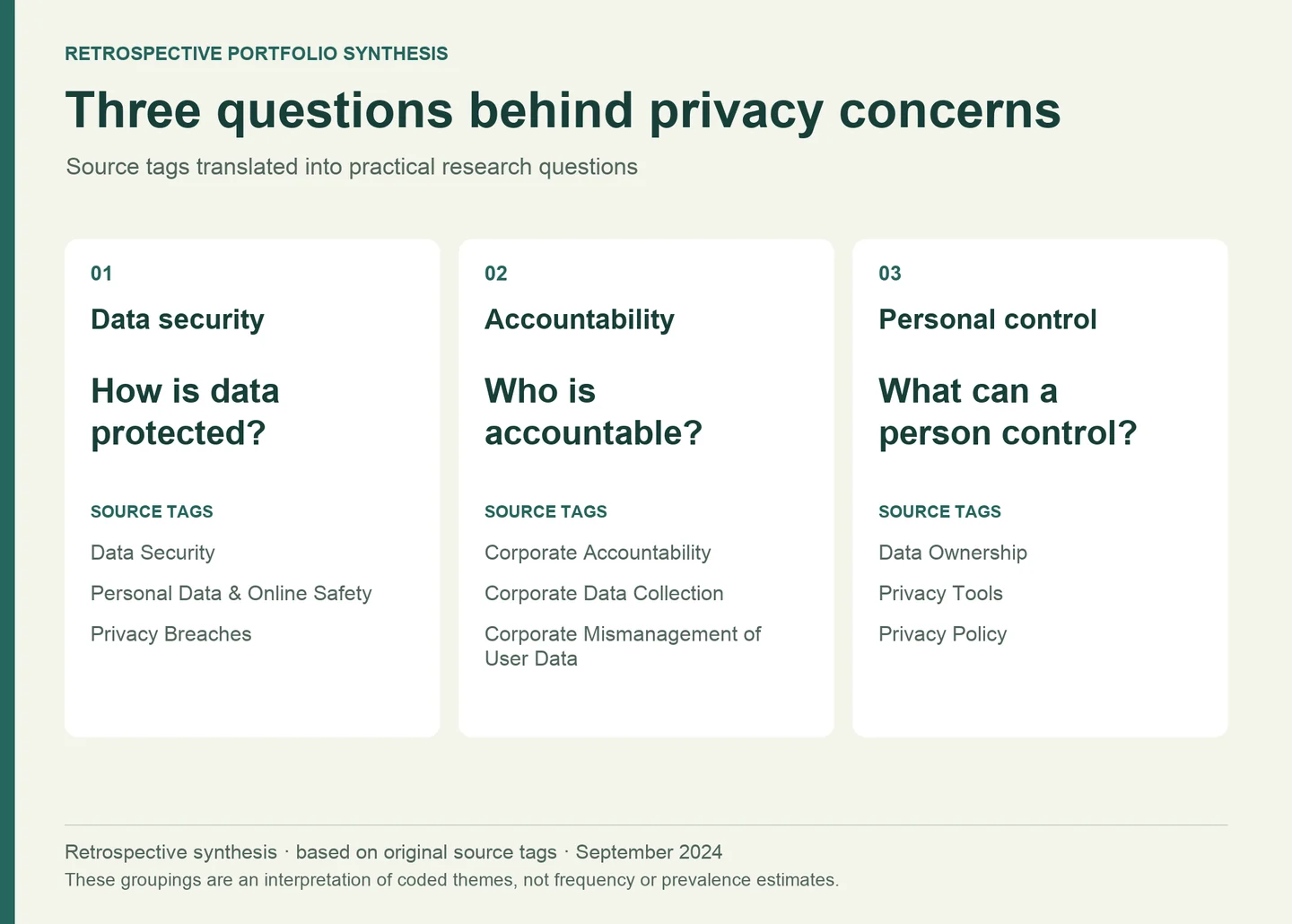
The coded material brought attention to how data is protected, who is accountable, and how much control a person has. I used those themes to make the trust question more specific. A product’s promise needed to connect to the concerns people were expressing in the community.
Reasoning and tradeoffs
Why this mattered
The synthesis distinguished concerns about data protection, corporate conduct, and usable control. It also described difficulty understanding privacy choices. Those concerns suggested different questions for a product that might explain policies and terms.
The options
The early synthesis proposed simpler explanations, clearer guidance, and product messaging about accountability. Another question remained: would understanding a policy address the person's underlying concern about what an organization actually does? The research needed to keep that distinction open.
The tradeoff
A clear explanation could make a privacy decision easier to understand. It would not, by itself, change a company's data practices or demonstrate that a person had more control. That distinction kept the promise under examination connected to the underlying need.
Use the uncertainty to reconsider the next study.
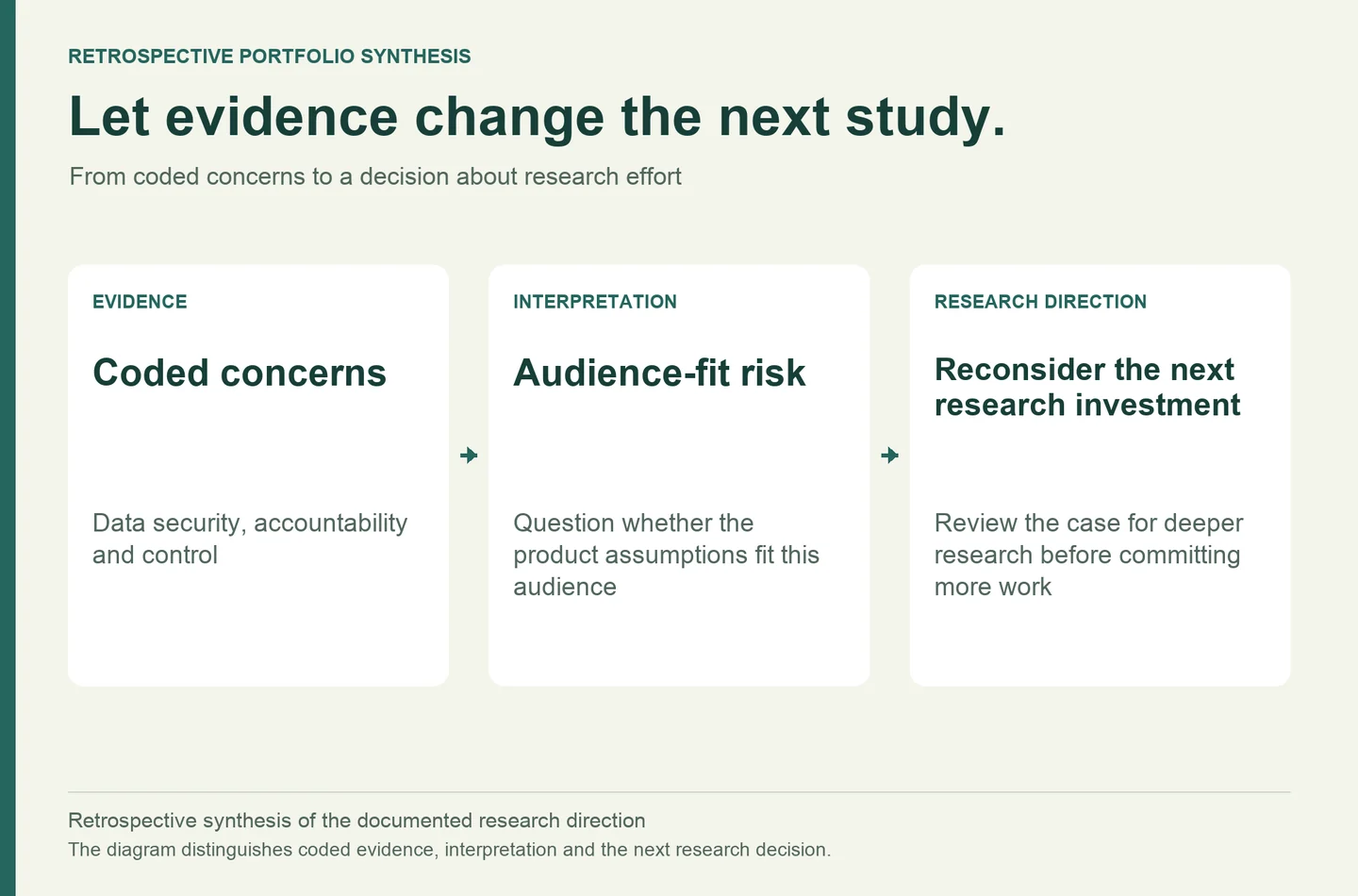
The findings raised concerns about the fit between the proposed experience and this audience’s priorities. I brought those concerns into the research discussion, supporting a reconsideration of deeper interviews and the next research investment. Community material was useful for identifying a risk; it could not establish product-market fit on its own.
Reasoning and tradeoffs
Why this mattered
The analysis raised a question about whether the audience needed a better explanation of privacy terms, a different kind of help, or a level of control the proposed direction did not establish. Deeper interviews in the same direction would only be useful if their purpose was clear.
The options
One direction was to refine the proposed explanation and guidance, then examine a concrete privacy decision. Another was to pause the planned deeper study and reconsider audience fit. The early synthesis supports the first direction as a proposal; the later project retrospective records the second as the direction taken.
The tradeoff
Pausing a study can preserve room to investigate a different uncertainty, but it also leaves questions unanswered. The community analysis could surface a fit risk. It could not prove that no one in the audience would adopt or that another segment would be a better market.
What the work produced
A sharper question about whom to serve next.
The work produced coded qualitative material and an audience synthesis that supported reconsidering the next research investment. It helped the team challenge an early assumption before committing to a deeper study in the same direction.
Why it matters for your project
I can help examine existing qualitative material, identify what it supports, and make the next research question more precise.
Evidence and delivery stage
September 2024 qualitative coding export and reviewed project retrospective. The retained source is partial and includes a privacy-community sample; no population prevalence or definitive product-market-fit conclusion is claimed. Visuals reformat source metadata and paraphrase themes; they do not reproduce participant quotations.
What does your next decision depend on?
Tell me what your team needs to understand. We can turn the question into a focused research scope.