Reported barrier
35%: unclear action steps
The report describes a need for specific, easy-to-follow instructions. This is one of five reported barriers; its per-item response base is unavailable.
 Kyle HobsonUX Research
Oak AI · Creator audience research
An audience survey connected reported barriers with a proposed direction for helping people take action.
Oak and creator Qasim Rashid were exploring ways to help an engaged audience turn shared values into useful action. Interest alone could not tell us what kind of support people needed, or what was getting in their way.
I led the survey’s creation, launch, and analysis. I brought together reported behaviors, barriers, tool interests, and open responses to identify where a product could make the next step easier.
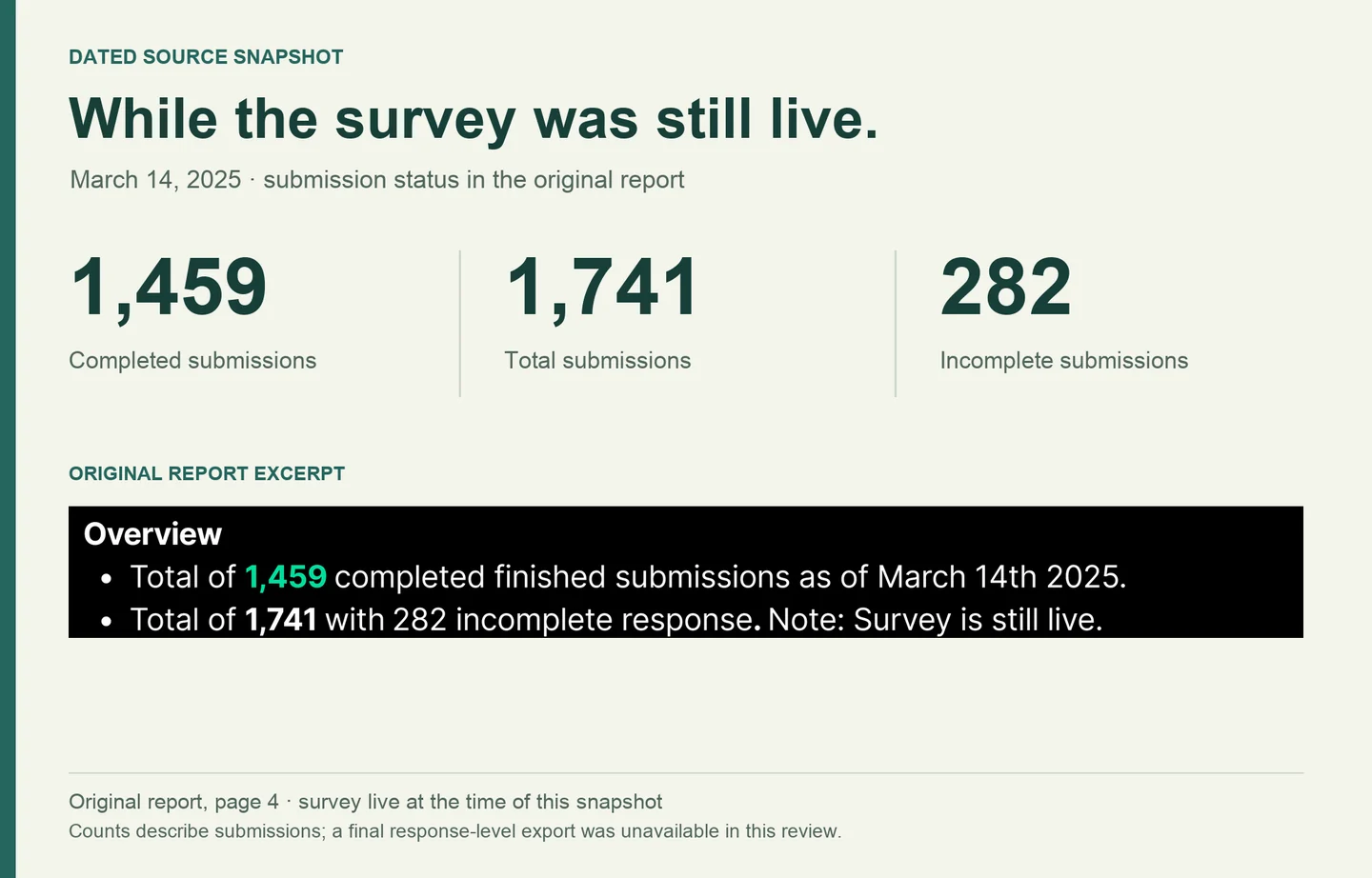
The survey asked about audience context, current behavior, barriers, and possible support. That let us look beyond general enthusiasm for a tool. At the March 14 snapshot, the study had 1,459 completed submissions out of 1,741 total submissions. Recruitment reached a voluntary creator and advocacy audience, so I treated the findings as directional for that audience.
The original objectives covered audience behavior, barriers, calls to action, and follow-through. Asking about those areas together made it possible to separate interest in a cause from the difficulty of deciding what to do next.
A question about interest in an action-support tool was part of the report, but it could not stand in for the behavior and barrier questions. The research frame kept both the appeal of a possible tool and the circumstances of action in view.
The survey gave us a broad view of this audience's self-reports. It provided less detail about how a specific person moved through a real action from start to finish. That remained a question for follow-up research.
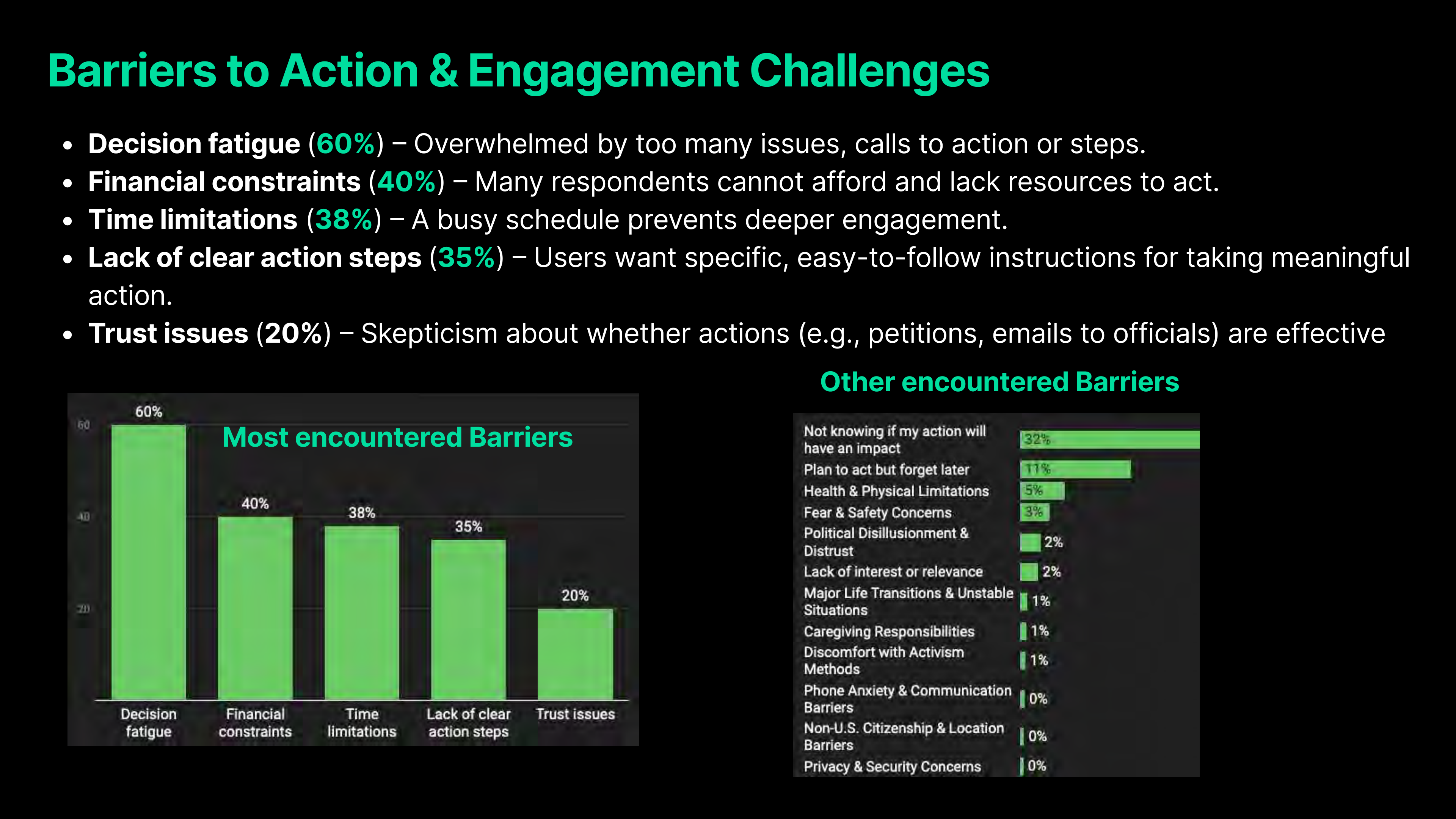
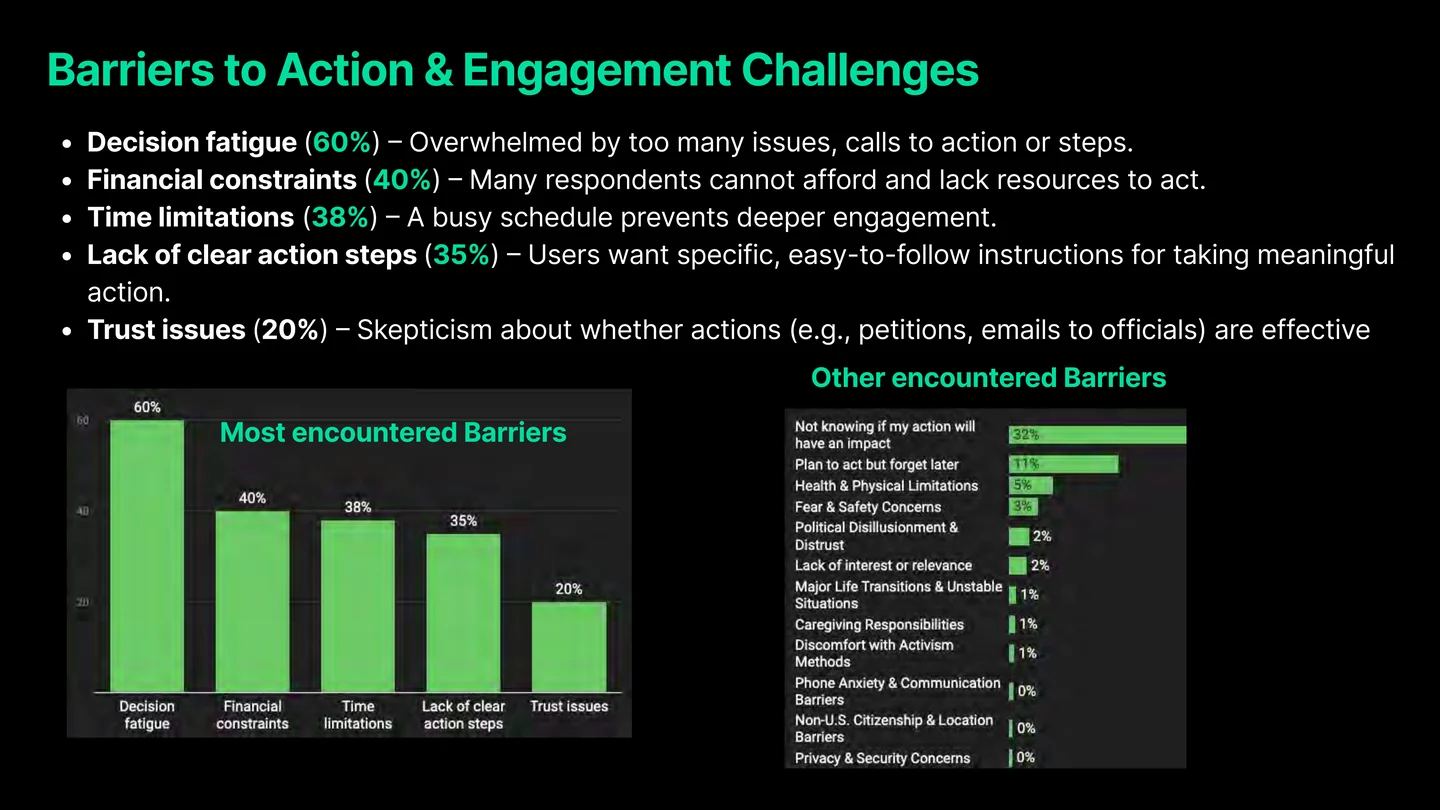
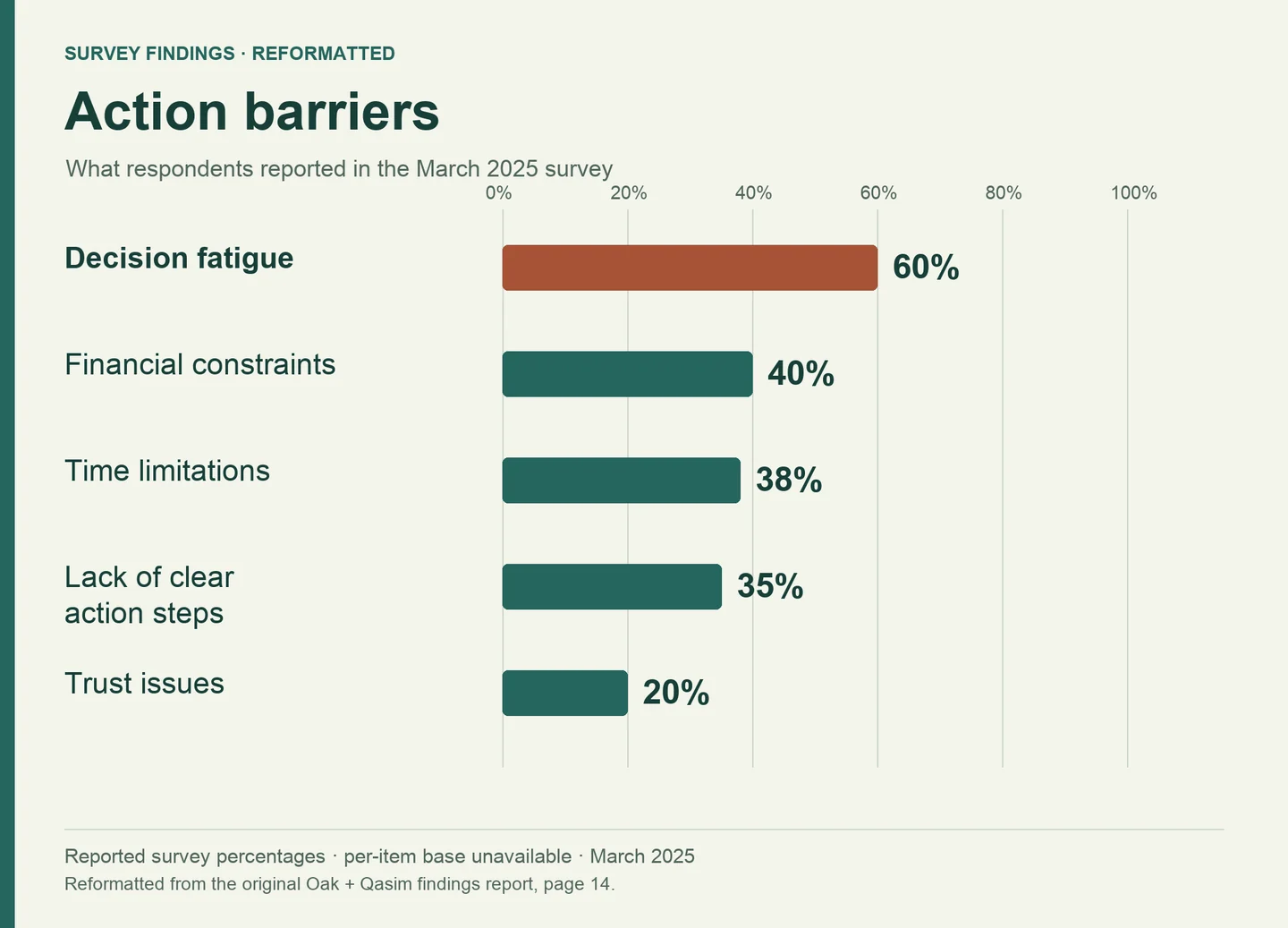
The report identified decision fatigue, money, time, unclear action steps, and trust as barriers. Decision fatigue was the largest of these reported percentages at 60%. This shifted the product discussion toward reducing the effort of choosing and starting an action. The report does not preserve a base for each item, so these percentages describe reported patterns rather than population estimates.
| Barrier | Reported percentage | What the report describes |
|---|---|---|
| Decision fatigue | 60% | Too many issues, calls to action, or steps. |
| Financial constraints | 40% | Limited money or resources available for action. |
| Time limitations | 38% | A busy schedule constraining involvement. |
| Unclear action steps | 35% | A need for specific, easy-to-follow instructions. |
| Trust issues | 20% | Doubts that an action would be effective. |
Directional self-report from a voluntary audience. The rows are not mutually exclusive categories established by the retained documentation.
The report's largest listed barrier was decision fatigue: too many issues, calls to action, or steps to work through. Money, time, unclear instructions, and doubts about effectiveness appeared alongside it. Those obstacles suggested different kinds of support.
Treating every obstacle as a need for more information would miss the distinction. A clear instruction could help someone understand a step, while limited time or money could still prevent them from taking it.
The percentages made the reported pattern easy to see, but the retained report does not include a response base for each item. I would use the pattern to frame candidate improvements, not to estimate how many people in a wider population had each need or to calculate how much a feature would help.
I recommended clearer action steps, reusable templates, reminders, and a way to see the impact of an action. Together, those recommendations informed the proposed Action Hub direction. The research gave the team a reason to focus on helping people act, rather than simply giving them more information.
Reported barrier
The report describes a need for specific, easy-to-follow instructions. This is one of five reported barriers; its per-item response base is unavailable.
Requested support
The report also summarizes requests for pre-filled outreach templates and simplified action steps. These requests suggest support worth exploring.

My proposed next test
I would test a focused outreach task with an editable template. The point is to see whether someone can move from understanding the request to taking the first step.
Connecting these two report sections is my interpretation; it does not establish that the same respondents selected both. The first-action flow is a proposed next test, not a tested interface or a measured Action Hub result.
The report connects reported obstacles with requests for practical support. Here is one path through that evidence: unclear action steps, requests for templates and simpler instructions, and a focused first-action flow I would test next.
The next product discussion could focus on a specific action a person could start and finish, with enough support around it. A larger catalogue of information would not, by itself, answer the reported difficulty of choosing and following through.
The requested support addressed some parts of the problem more directly than others. A template could reduce the effort of starting a message; it would not remove a financial constraint or prove that the message had an effect. Those limits mattered when defining what the proposal could reasonably promise.
What the work produced
The study produced an audience findings report and recommendations for a proposed Action Hub. It connected the audience’s reported obstacles to specific forms of support the team could explore: a clear step, a useful template, a reminder, and visible impact.
I can help turn an audience question into a study and connect the findings to a product decision.
March 2025 Oak / Qasim survey findings report and reviewed project retrospective. Counts are the March 14 snapshot, not a final deduplicated sample. Voluntary self-report limits generalization; product adoption and business impact were not measured in the supplied evidence.
Tell me what your team needs to understand. We can turn the question into a focused research scope.