


Give the team something concrete to think with.
I designed an in-person workshop sequence combining opportunity statements, individual sketches, gallery sharing, and a plan for prioritizing the next directions.
- Role
- UX Research Consultant · workshop sequence and documentation
- When
- May–June 2025
- Scope
- Problem framing, individual sketching, gallery sharing, synthesis
- Work stage
- Workshop materials and collaborative follow-on directions
- The group task
- Make and compare an ideal Year in Review for a memory-keeping product.
- My contribution
- In-person activity sequence, documentation, and synthesis support.
- The result
- A retained workshop record and follow-on design discussions.
The problem
The team was exploring how people begin, revisit, and share memories. To discuss those ideas usefully, we needed to make them concrete without immediately flattening them into a feature list.
The workshop’s raw notes return to a basic difficulty: where does someone start when keeping a memory? Rather than resolve that question through discussion alone, the session asked the team to imagine an end result worth working toward.
My role
I designed and circulated the in-person activity sequence, then helped document the workshop outputs and subsequent synthesis. The preparation and ideas were collaborative; I did not originate every concept.
I authored and sent the in-person agenda. Broader preparation and workshop ideas came from the team; the final record is collaborative.
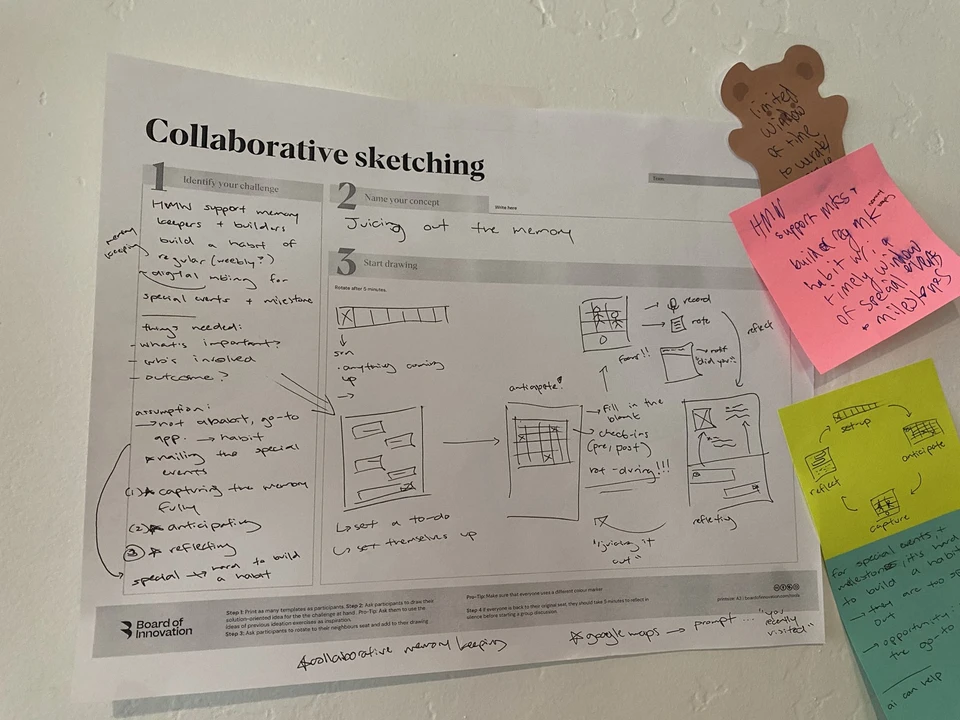
Original team workshop materials · 2025
Open original imageDecision 01
Start with a shared question, then give people room to make.
The agenda moved from opportunity statements and How Might We questions into individual sketches. Participants could draw, write, use Figma, or storyboard their ideal Year in Review. Different ways to contribute served the same concrete task.
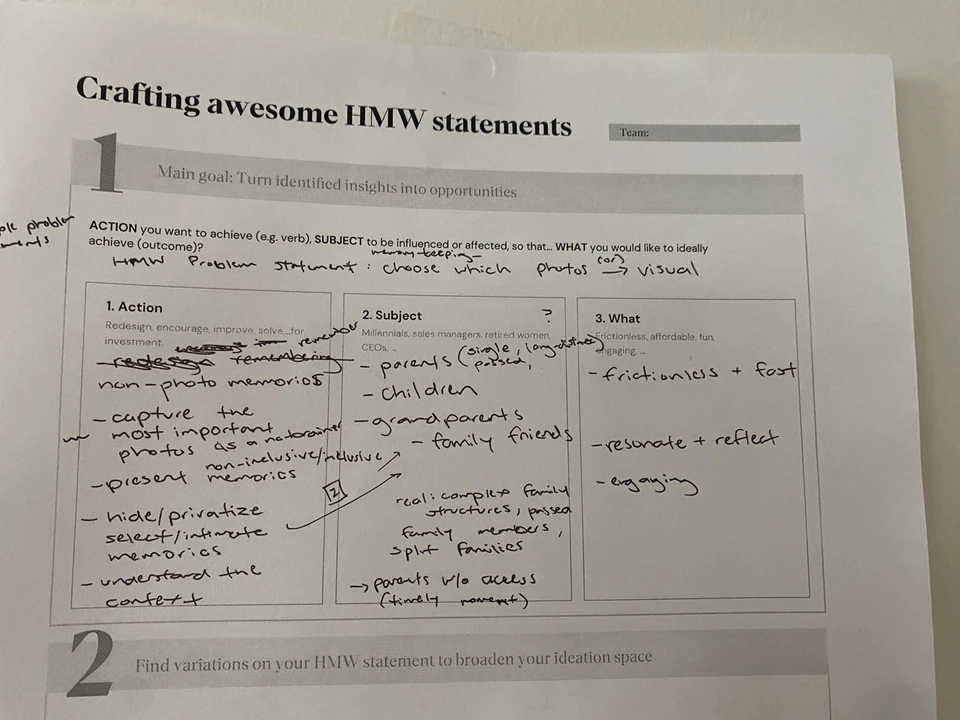
Original KeepMake team worksheet, 2025. Template: Board of Innovation. Handwritten ideas are collaborative.
Open original imageFrom the original run of show
| Planned stage | What participants were asked to do |
|---|---|
| Warm-up | Timed pitches for the same product, following a personal opening question |
| Problem framing | Craft and share opportunity statements |
| How Might We | Frame possibilities and identify themes |
| Individual sketching | Draw, write, or storyboard a personally meaningful Year in Review |
| Gallery walk | Present sketches, list features, and discuss themes |
| Prioritization | Arrange directions into Now / Next / Later |
Decision 02
Put the end state on the table.
An ideal Year in Review gave the team an artifact to explain and compare. The gallery walk called for timed presentations, then themes and a Now / Next / Later view. Those were the planned activities; the retained notes show the ideas the team continued working through.
Original KeepMake collaborative-sketching sheet, 2025. Template: Board of Innovation; team-generated concepts.
Open original imageThe artifact participants were asked to make
The original prompt allowed a physical sketch, an outline, a Figma design, or a short storyboard. It asked people to consider their own end-of-year memory review and break it into elements and features.
Sketch Your Ideal “End-of-the-Year Review” Output
Heading quoted from the original agenda; instructions summarized.
Individual work created material for group discussion. The source does not establish that every planned activity ran exactly as scheduled.
Decision 03
Keep the original ideas visible through synthesis.
The workshop record retained raw problems and How Might We variations before later synthesis and user-story revisions. That separation matters: a team-generated idea needs to remain distinguishable from a finding established through user research.
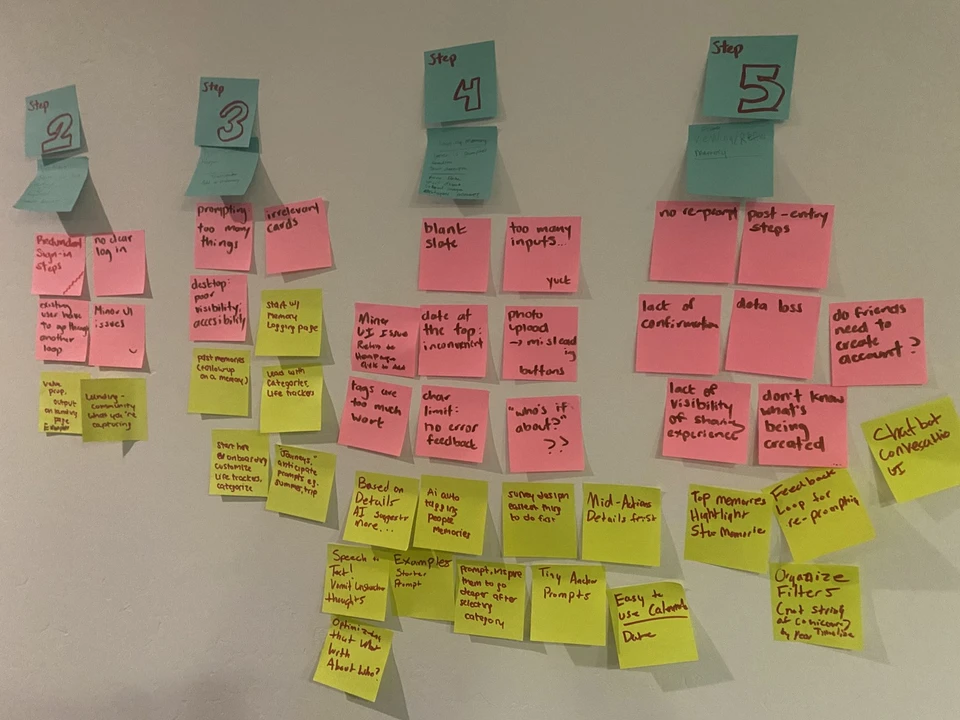
Original KeepMake workshop wall, 2025. Team observations and ideas, not validated user findings or shipped features.
Open original imagePreserve the raw question before combining ideas
| Source layer | Selected original excerpt | How I treat it |
|---|---|---|
| Raw problem note | Blank screens = unhelpful | A recorded team statement, not a research finding |
| How Might We variation | How might we choose which photos (or) visual memory keeping? | An exploratory question preserved in the source |
| Later synthesis | Workshop-derived user stories and directions | Interpretation for discussion, still requiring validation |
- Constraints and tradeoffs
- Synthesis makes a large set of ideas usable, but merging too early can erase differences. Keeping the originals gives the team a way to revisit a theme.
Evidence behind this account
The source explicitly preserves repeats and near-repeats and distinguishes the workshop iteration from past research.
A workshop record the team could continue working with.
The retained agenda, workshop notes, and June follow-on comments show a concrete body of ideas and continuing collaboration. The output included problem statements, How Might We questions, sketches, and directions for further product work.
Leave room for people as well as activities.
A colleague’s request for a reset break reminded me to plan for people as carefully as activities. In future sessions, I would make breaks, transitions, and different ways to contribute explicit in the run of show.
The next question I would test
Connect each prioritized direction to its assumption, owner, and next research or design step.
A productive workshop leaves behind both the ideas and enough context to challenge them later.
I would check whether each priority has an owner, an explicit assumption, and a next validation step before treating it as a product commitment.
Evidence and limits
My May 2025 agenda, collaborative meetup record, and original workshop photographs from my earlier portfolio. The work shown is product-team ideation. Board of Innovation worksheet templates retain their attribution.
