
Arizona State University · Learning Innovations
Make human review part of the AI workflow.
At ASU, I proposed a staged workflow for personalized learner tasks, with mentor review of both context and generated output.
- My role
- AI Analyst
- Period
- February–October 2024
- Delivery stage
- Proposed prompt architecture · deployment unverified
The problem
Personalized learner tasks depend on an accurate understanding of the learner and appropriate guidance. The workflow needed a way for a mentor to check the context and review proposed tasks before they reached the learner.
My contribution
As an AI Analyst at ASU Learning Innovations, I proposed a prompt architecture within a collaborative project. My proposal connected learner context, task generation, mentor review and structured output.
Check the context before generating tasks.
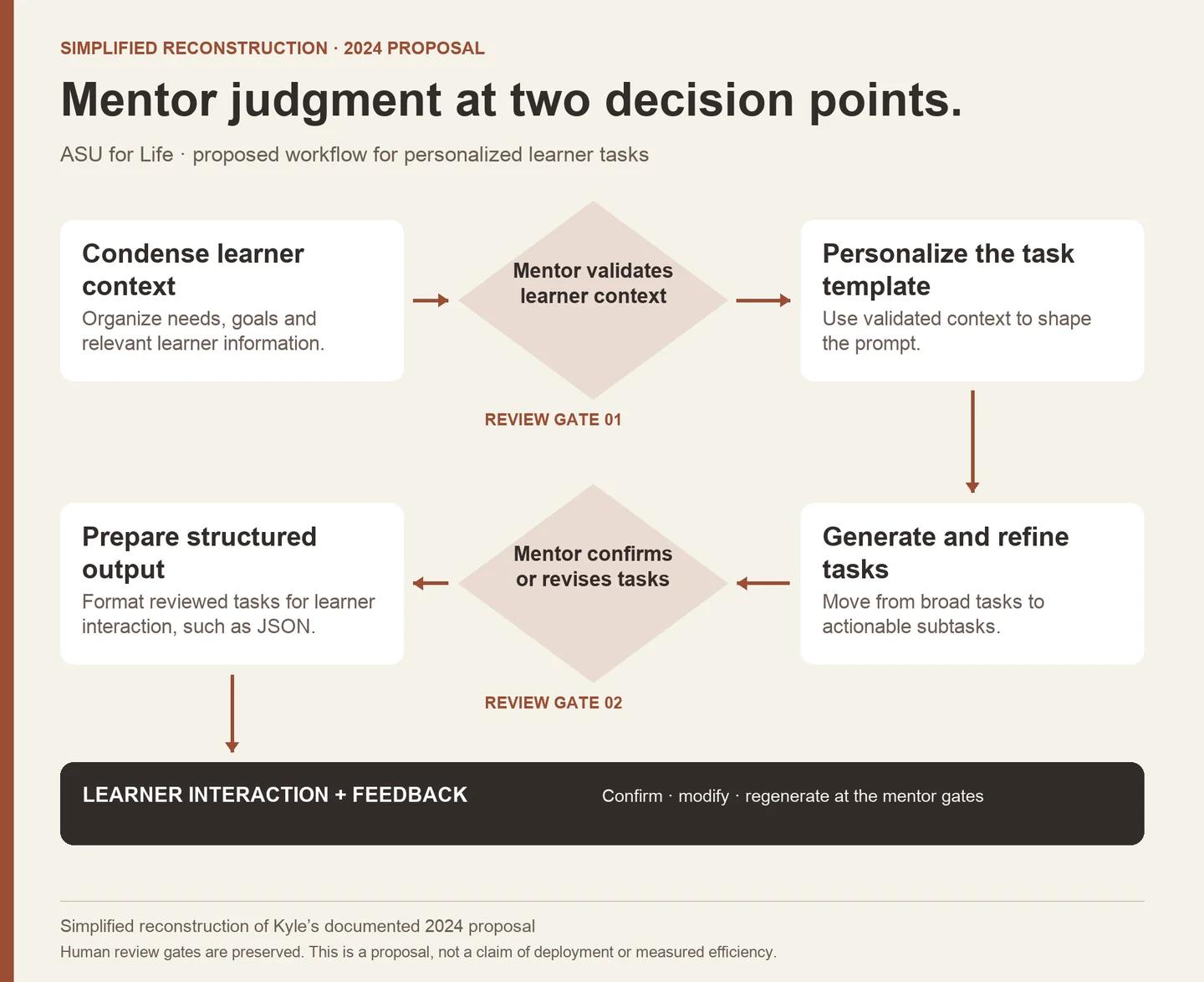
The proposal first condensed the learner’s needs and goals. A mentor would validate that summary before it shaped a personalized task template. This made the initial interpretation a reviewable decision.
Move from a broad task to something actionable.
I proposed generating broad tasks, breaking them into subtasks and refining them for clarity. The staged approach made the intended transformation explicit, so a mentor could examine more than a final answer.
Review the output before it reaches the learner.
A mentor would confirm, revise or regenerate the proposed tasks before structured output, such as JSON, moved into the learner interaction. Learner feedback would then inform the next iteration. These are proposed review points, not a record of production use.
What the work produced
A concrete architecture for discussion.
The proposal made the steps and mentor decisions visible in the collaborative architecture work. The retained evidence supports that design contribution; it does not establish deployment, reduced mentor workload or learner outcomes.
Why it matters for your project
I can help turn an AI idea into a workflow with explicit inputs, responsibilities and review points before a team commits to implementation.
Evidence and delivery stage
Original 2024 collaborative architecture document, the section explicitly attributed to Kyle, and its flowchart. The visual is a simplified reconstruction of my proposal; it omits speculative components of the broader artifact. This is workflow and prompt design, not a claim of model training.
What would you like AI to help with?
Tell me about the task and what a useful result would look like. We can find a concrete starting point.